COLLECTING TECHNIQUES ≠ LEARNING JIU JITSU

Being able to reproduce a technique does not necessarily mean you understand the Jiu Jitsu behind it.
You can be shown a sweep, drill it on a non-resisting training partner and become very good at reproducing the movement. You might remember every step. Your hand goes here. Your foot goes there. You move your hips this way. Your training partner gives you the reaction you're expecting and you complete the sweep.
But what happens when they don't?
What happens when the resistance is turned up? What happens when their weight isn't where you expected it to be? What happens when they change their base, apply pressure differently, take away the grip you were expecting or simply give you a completely different reaction?
If the technique suddenly falls apart and you don't understand why, then you didn't properly understand the position in the first place.
You learned a move.
That's not the same thing as learning Jiu Jitsu.
At Atomic, we believe there is a fundamental difference between being able to reproduce a technique and understanding why that technique works.
If your understanding of a sweep is simply that you do A, then B, then C, you're in trouble the moment your opponent prevents you from getting to C.
Jiu Jitsu doesn't happen against a compliant training partner. It happens against another human being who is actively trying to stop you from doing what you want to do.
Their reactions won't always be the ones you practised.
And that's the point.
A technique that only works when your training partner gives you the reaction you were expecting isn't yet Jiu Jitsu you understand.
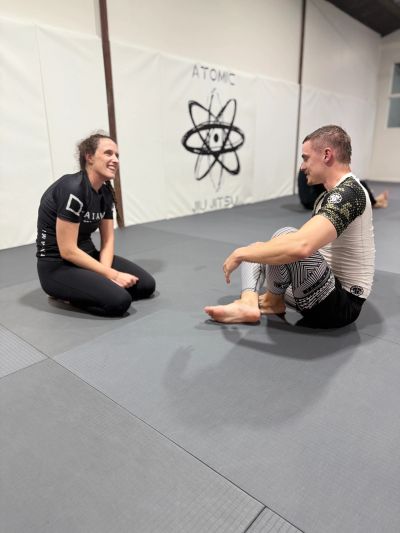
Understanding the Position
This is one of the reasons we place so much emphasis on understanding positions rather than simply accumulating techniques.
If we're teaching Half Guard, for example, we don't want our students to leave knowing five Half Guard techniques.
We want them to understand Half Guard -
- What makes the position strong?
- What makes it weak?
- Where does control come from?
- Where are the pressure points?
- What is the bottom player trying to achieve?
- What is the top player trying to prevent?
- What happens to the position when someone's weight moves?
- Where is their base strong?
- Where is it vulnerable?
- What reactions can we reasonably expect, and what opportunities do those reactions create?
You cannot properly understand a position by only looking at one side of it.
That's why we teach both.
If you're learning to play a position from the bottom, you also need to understand what the person on top is trying to do to defeat it. If you're learning to pass a guard, you need to understand what makes that guard effective in the first place.
The two sides inform one another.
Understanding why somebody can shut your position down teaches you something about what made the position work.
Understanding why a pass fails teaches you something about the control you haven't established.
Understanding why somebody can recover their guard teaches you something about the space or movement you failed to control.
The failure isn't separate from the learning.
It is part of the learning.
Drilling Matters
None of this means we don't believe in drilling.
We absolutely do.
Drilling gives students repetition. It develops movement patterns. It allows someone to perform an unfamiliar movement repeatedly without the complexity of having another person actively trying to stop them.
That's enormously valuable.
You have to learn the movement before you can reasonably expect to perform it against resistance.
But drilling is a part of learning Jiu Jitsu. It isn't the end of it.
Eventually the resistance has to change.
The reactions have to change.
The position has to become less predictable.
And the student has to start making decisions.
That's where experimentation becomes important.
You try something.
It works.
You try it again against somebody different and it doesn't.
Why?
Maybe their base was different.
Maybe you didn't control the position properly.
Maybe you attempted the technique at the wrong time.
Maybe the reaction you were trying to exploit simply wasn't there.
That doesn't necessarily mean the technique is bad.
It means there is something about the position you don't yet understand.
So you go back.
You drill.
You experiment.
You ask questions.
You make adjustments.
And then you pressure-test it again.
Over time, you're no longer simply trying to reproduce the
movement you were shown.
You're beginning to understand the problem that movement was designed to solve.
The Other Extreme
There is another extreme that we don't believe develops complete grapplers either.
Simply placing students into constrained situations and asking them to discover their own solutions isn't, by itself, teaching them Jiu Jitsu.
Experimentation is incredibly valuable. We actively encourage it.
But experimentation is most useful when it is supported by technical knowledge and an understanding of the position.
Jiu Jitsu has been developed, tested and refined by generations of grapplers.
There is an enormous body of technical knowledge available to us. We don't believe students should have to independently rediscover that knowledge from scratch.
Our responsibility as instructors is to give students that knowledge and then create opportunities for them to understand it.
We teach the technique.
We explain the principles that make it work.
We drill it.
We explore the position around it.
We look at the other side of the problem.
Then we allow resistance, experimentation and live training to expose what the student actually understands.
Those things aren't competing approaches.
For us, they're parts of the same learning process.
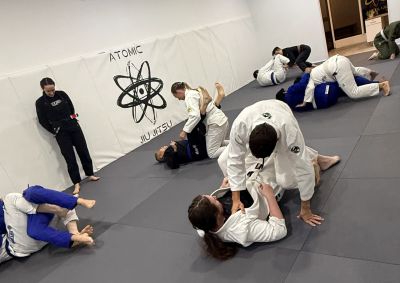
Developing Grapplers, Not Collectors of Techniques
Ultimately, our objective isn't to produce students who can demonstrate the greatest number of techniques.
Knowing 500 moves doesn't necessarily make somebody better at Jiu Jitsu than somebody who knows 100.
The question is what they understand.
Can they recognise the problem in front of them?
Can they understand what their opponent is trying to achieve?
Can they identify where control is coming from?
Can they recognise when a position has changed?
Can they adjust when the expected reaction doesn't occur?
Can they use the principles they've learned to solve a problem they haven't encountered in exactly that form before?
That's what we're trying to develop.
Well-rounded grapplers who can think, experiment and make decisions under resistance.
Drilling gives you repetition.
Experimentation gives you understanding.
Resistance gives you proof.
Learning moves matters.
But learning moves is not learning Jiu Jitsu.